
Unending scourge: Scooping fuel from fallen tankers persists
- Super Admin
- 07 Mar, 2026

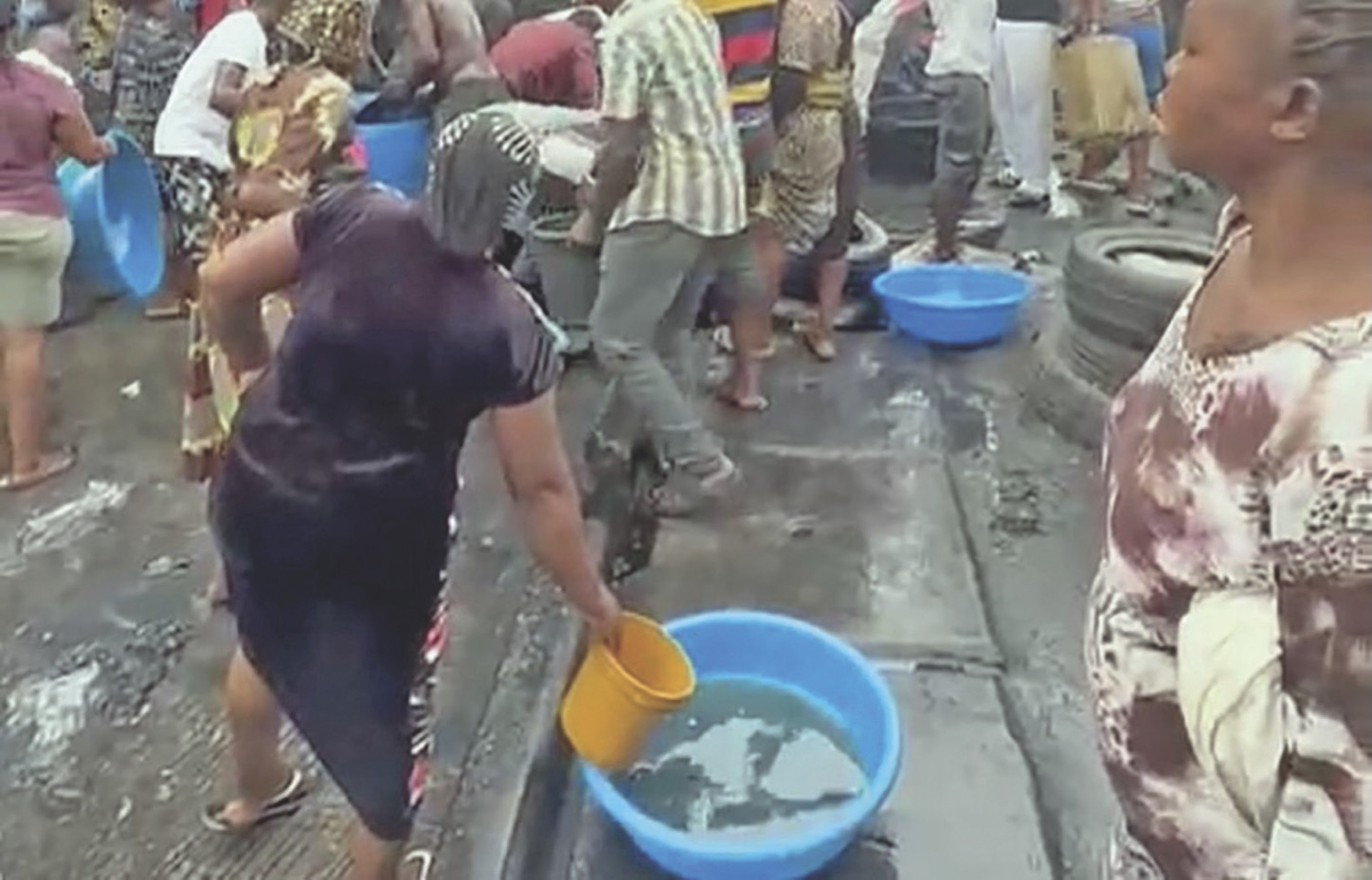
On Monday, January 19, a 33,000-litre diesel-laden tanker operated by NIPCO Ltd, lost control and overturned, spilling a large volume of diesel on the road beneath. The incident which took place at Liverpool Bridge inward Mile 2, in the Apapa area of Lagos witnessed desperate residents, business owners and workers in the area come out in their hundreds to scoop the product into buckets and other containers. Danger was averted following the prompt intervention of Lagos State Emergency Corps and other government agencies that arrived at the scene to disperse the people. After so many tragic and avoidable deaths from scooping fuel spilled from crashed tankers, many Nigerians appear not to have learnt any lesson yet. The Apapa incident was the latest of the several incidents where people would engage in this reckless, near-fatal act. The incident, Saturday Sun gathered, has raised issues about safety of the people, measures to be taken to avoid acts that could lead to death of several people, as well as the introduction of laws that will criminalise scooping of fuel in Nigeria. "Anytime a tanker falls, the next thing is that you see people around the venue of the incident scooping from the fallen tanker and making away with the contents. "Whether PMS or Diesel, people will scoop without having a thought about the disaster their actions may cause. "Many Nigerians have been killed as a result of scooping fuel from fallen fuel-laden tankers, and the casualty figures are rising by the day," Hon. Olumuyiwa Adesua, said as he reacted to the dangers of the act. Adesua urged the National Assembly to enact a law against fuel scooping in Nigeria, even as he urged the police to arrest anybody found at the scene of such an incident. According to him, many of those involved in such acts are driven by greed and poverty and they are unmindful of the dangers of scooping fuel from a fallen tanker. "They are also ignorant of the fact that such dangerous engagement can lead to explosions that could also lead to death and cause serious harm to other people," he said. An industrial physicist, Mr. Donatus Anyaegbu described fuel scooping from a fallen tanker as a suicidal act that is very dangerous to both the scooper and to the society. Anyaegbu highlighted poverty as one of the causes, even as he urged the Federal Government to continue sensitising the public on the dangers of fuel scooping. "First of all, we should know that scooping of fuel from an accidental tanker is a suicidal act. So, anybody embarking on such an act must know that it is either way- to scoop the fuel alive or get roasted in the inferno at the slightest spark. "It is either you go and you get the fuel and come back, or you go and you don't come back. It is such a risky adventure. We must always remember that fuel is a highly combustible substance made of hydrocarbons. "It is highly combustible and a little strike can ignite it and cause humongous damage. So, for somebody to know this very well and still decide to take such risk, maybe, just because of five litres of fuel or even two litres or even if it is going to be 50 litres, 100 litres, why should anybody take such risk at the expense of his life? "How much is the person trying to make? But then you look at the situation of things in our country now, it is not easy for many people to cater to their needs but a reasonable person cannot engage in such a suicidal act because of maybe N1,000, N2,000 or even N5,000. "I think it has to do with the level of poverty in the country and such a thing has to be discouraged because when you look at the implications, it is more dangerous than the level of poverty in the country. "Then that brings us to the role of the government. Our government should try as much as possible to discourage people from such acts, either by enlightenment and also educating the people on the risks and dangers of such acts. "There is an urgent need to tell the people, the dangers involved in scooping for those that might not know because when such things happen, when there's an inferno, or fire outbreak, it's not only those people that scoop that are going to suffer for it at the end of the day. "Whenever there's an inferno, it engulfs the whole vicinity; both the rich and the poor will suffer for it at the end of the day. "I am appealing to the government at all levels to discourage people from such acts by trying as much as they can to create an enabling environment for people to survive, so that people will stop scooping and stop endangering their lives. "What leads to this is abject poverty. When somebody is not sure of his next meal, I mean, what he will eat, maybe in the morning, in the afternoon or night, he's not sure. So, he will do anything to try and put food on his or her table, thereby endangering his life and the lives of other people in the society. "You can't see such unlawful acts in a civilised society, therefore, it has to be highly discouraged," he stated. Lagos-based businessman, Mr. John Chukwu explained that the Liverpool incident was based on greed and poverty. Chukwu said it is unfortunate that people could risk their lives in such a manner. He wondered how a right-thinking person could take that level of risk of scooping fuel from a fallen tanker, pointing out also that a spark at the scene of the incident can lead to unimaginable disaster. "I don't pity anybody involved in fuel scooping, because of the risk that is involved. No reasonable person will be involved in such a disastrous act. At times, we blame the government for incidents that are not ordinarily their fault. "Most times, we see on television and hear on radio the dangers of fuel scooping. The enlightenment is for us to stay away from incidents that can trigger fire outbreaks, like fuel scooping and several other incidents. "Apart from enlightenment programmes, the government should also try to provide employment opportunities for Nigerians. It is only those that are greedy, unemployed and ignorant of the dangers of fuel scooping that can get involved in the act," he stated. Mr. Hammed Oluwatosin, a fashion designer told Saturday Sun that it is only those who don't value their lives that engage in fuel scooping. He narrated his experience when a fuel laden tanker lost control and spilled its content. According to him, he quickly alerted the people of the area and left the scene because he knew the extent of damage such an incident could cause. "I am always alert, if an incident of that nature happens, I will quickly leave the scene and seek safety. Fire outbreak coming from fuel spillage is not something you can predict. It can escalate into a complete inferno. So, when such things happen, the best thing to do is to stay away from the scene of the incident." Oluwatosin explained further that whether fuel scooping becomes a criminal offence or not, it doesn't matter, what matters, he said, is the ability to identify the dangers of fuel scooping and refrain from engaging in it. "The Lagos State government is doing its best in the area of sensitisation but there should be more to this. Regular advice on the radio and television will also help in changing the ugly narratives," he said. Also reacting, Director General of the National Orientation Agency (NOA) Mallam Lanre Issa-Onilu, has called on the National Assembly to criminalise the act of scooping fuel from fallen tankers. The announcement was made in a statement posted on the NOA's official X account. NOA's call came amid growing concerns over repeated fuel tanker accidents following a recent incident at Apapa. Issa-Onilu condemned the practice in the strongest terms, describing it as dangerous, irresponsible, and wholly unacceptable in a modern society. He highlighted that the risks extend beyond those directly involved, threatening motorists, nearby communities, emergency responders, and national infrastructure. "This is not poverty. Poverty does not take away the sense in people's heads, nor does it eliminate judgment or the instinct for self-preservation. What we are witnessing is a conscious, reckless, and criminal disregard for human life and public safety," he said. According to the DG, the NOA has long conducted nationwide sensitisation campaigns to educate Nigerians on the dangers of fuel scooping from accident scenes, yet some individuals continue to engage in the act despite repeated warnings. He urged the National Assembly to enact legislation that criminalises fuel scooping and also prescribes clear, deterrent penalties for offenders. Issa-Onilu stated further that public enlightenment must now be complemented with enforcement measures to end this risky behaviour. Meanwhile, President General of the Coalition of South East Youth Leaders (COSEYL), Comrade Goodluck Ibem has called on the government to end recurrent fuel tanker accidents and prevent loss of lives in the South East and Nigeria as a whole. In a statement on Tuesday, Ibem said the rising spate of fuel tanker accidents and scooping of fuel in Nigeria was alarming. The youth leader expressed deep concern over the recurring incidents of fuel tanker accidents on Nigerian roads, particularly within the South-East region, which have repeatedly resulted in avoidable loss of lives and destruction of property. "In many of these tragic incidents, fuel tanker incidents happen due to poor road conditions, mechanical failure, overloading, and weak regulatory enforcement. "Sadly, desperate citizens often rush to scoop spilled fuel, a situation that has on several occasions led to deadly fire outbreaks, wiping out entire families and communities in seconds. COSEYL strongly condemned this continuous loss of human lives and described it as a national failure that requires urgent and coordinated government intervention." The group, while calling on both the federal and state governments to fix and maintain critical road infrastructure, said many fuel tanker accidents are directly linked to bad and dilapidated roads. "Government must urgently rehabilitate federal and state highways used for petroleum transportation, especially in high-risk corridors. It should also enforce strict regulation of fuel tankers, insisting that relevant agencies like the Federal Road Safety Commission (FRSC) Nigerian Midstream and Downstream Petroleum Regulatory Authority (NMDPRA) and DPR must ensure that only road-worthy tankers are allowed to operate." The group also suggested routine mechanical inspections, limits on tanker age, and strict penalties for overloading must be enforced without compromise. COSEYL also urged the Federal Government to establish a rapid emergency response unit. "Government should deploy well-equipped emergency response teams along major highways to immediately cordon off accident scenes, evacuate residents, and prevent civilians from approaching spilled fuel." It stated that with regular public safety awareness campaigns and sustained nationwide sensitisation on the dangers of fuel scooping, Nigerians would understand that spilled fuel is a death trap, not an opportunity for survival. "Government must always address the underlying poverty that drives people to risk their lives scooping fuel by strengthening social safety nets, youth employment programmes, and economic empowerment initiatives." The group also urged the government to act decisively, even as it stated that if the cost of inaction is measured in human lives, that price is far too high. In the same vein, Director of Operations, Lagos State Emergency Management, Engr. Olatunde Akinsanya, also warned residents against scooping fuel from tankers. Akinsanya responded to the recent accident at Tincan, Liverpool Bridge Apapa. He warned that safety and compliance during critical incidents was key to prevent further crises. The LASEMA boss stated that Lagos State Government under Governor Babajide Sanwo-Olu is doing its best to ensure safety considering the dangers of fuel spillage and scooping. He added that the Lagos State government has been engaging in regular public enlightenment in order to sensitise Lagosians that when there is a critical situation like the incident that at the scene of the incident should stay away from the scene and allow the state officials to do their jobs. "Lagosians should continue to support the state government in ensuring safety, rather than engaging in fuel scooping. The right thing is to stay away from the scene of the incident and allow the state officials to do their jobs. "Spillage of fuel and other contents are highly inflammable. Nobody can determine the extent of damages or wreckage. Governor Babajide Sanwo-Olu is doing a lot in the area of public enlightenment and engagement on the best way to avoid fire outbreaks or any impending danger across the state. Fuel scooping is dangerous and we must desist from acts that can lead to loss of lives. Source: https://thesun.ng/unending-scourge-scooping-fuel-from-fallen-tankers-persists/
Leave a Reply
Your email address will not be published. Required fields are marked *