
BJ: The many sides to an irrepressible scholar and patriot -
- Super Admin
- 08 Mar, 2026

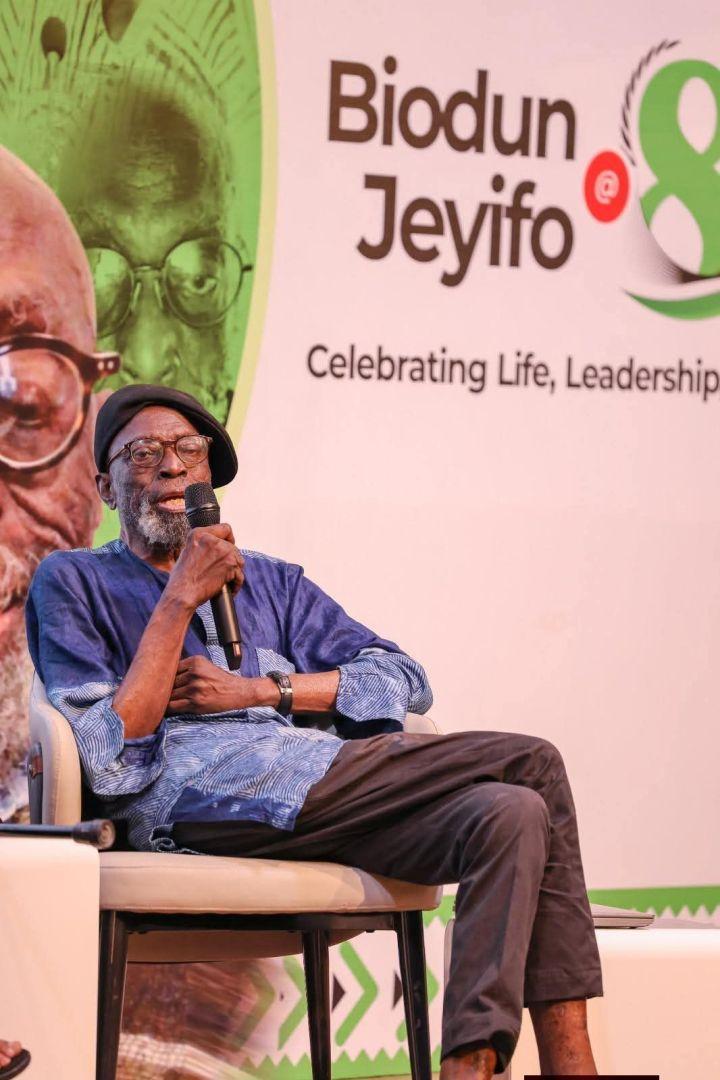
In life, Biodun Jeyifo was many things at once: a scholar of formidable range, a Marxist critic with a poet's sensitivity, a unionist who believed fiercely in justice, and a teacher whose intellectual generosity shaped generations across continents. But to friends and students, he was simply BJ -- a booming voice, a restless mind, and a man who refused to separate scholarship from the struggle for a better society. And the uncanny way he built bridges, broke boundaries, collapsed differences, and combined the seriousness of an intellectual with the everyday concerns and pastime of the people, especially the poor was what endeared him to many. He was indeed at home with the rich and the poor, the highbrow and the unsophisticated as well as the cultured and the uncultured. Yet at the heart of his social interactions, his encounters with people, was his legendary generosity, his deep concerns for the plight of the poor, his boundless appetite for conversations and unbridled capacity for letting his guards down, which many sometimes mistook for a carefree attitude. And many will never forget the way his berets and hats always sat slantingly on his cerebral head, his characteristic smile, his inquisitive questions and insatiable intellectual curiosities. Yet he was simple in his complexity and complex in his simplicity This is indeed the story of BJ. And It was for these and many other reasons that his family, former students, comrades, colleagues and friends converged on the Omolayole Hall at the International Conference Centre, University of Ibadan to celebrate the man whose life not only traversed Ibadan, New York, Cornell, Harvard and Beijing and whose mind had shaped theirs on an evening of Tributes held in his honour on Tuesday, March 3 2026. It would be recalled that Jeyifo passed away on February 11, a month and five days after he celebrated his 80th birthday in Lagos. It was indeed an evening of tributes, of memory, of strings of appreciation and of course laughter. It was also an evening of celebration of a man who spent his life molding minds, nurturing students and fighting not just for the common good but for the betterment of the masses. The AJ Sequential Highlife Band and Ibadan City Chorale pepped up the evening with classic highlife music and soul-stirring songs respectively. And indeed Dr Yemi Ogunbiyi, BJ's childhood friend and colleague who anchored the event, set the tone for the evening in his brief welcome address, when he described the event as "the celebration of a life, one person who meant many things to the world to us." It is also instructive to note that the tributes that poured in built the portrait of a man who was at once brilliant, irreverent, disciplined, compassionate and endlessly curious. Dr. Solomon Ladipo, another of BJ's childhood friend and classmate at Ibadan Boy's High School said the renowned scholar's love for literature and the arts was nurtured during the period under the tutelage of Pa Modupe Oduyoye, himself an old boy of the school now over 90 years old and two American teachers at the time , Mr Alexander Severance and Mr Schuh, who brought along several books by American authors. "It was also during that period that his passion for the oppressed manifested," Ladipo reminisced, adding that his academic brilliance became apparent when he came on top of his class in June 1970 with first-class honours, a feat which made him the third person with that class of degree in the history of the department established in 1948. Prof. Rasheed Olaniyi, spoke in two capacities, as Dean, Faculty of Arts, University of Ibadan and as the representative of the President of the Nigerian Academy of Letters, Prof Andrew Haruna. Olaniyi described BJ as a great bridge, between the intellectual world and the common man on the streets of Nigeria, and of course, Africa, and by extension, the whole world. "We are gathered tonight not to witness the closing of a book, but to celebrate a library that refused to stay quiet. We are here to honour Emeritus Professor Biodun Jeyifo, our BJ, a man who spends 80 years proving that the sharpest weapon in any revolution is a mind that refuses to be bought "BJ was a real intellectual who could navigate the society of high theory without ever losing the dust of Ibadan streets on his shoes. To BJ, literature was never a pastime. It was a social mandate. He taught us that when we read a play or a poem, we are not just looking at words. We are looking at the architecture of our freedom. "BJ has not departed in the final sense. He has simply transited into the very works he wrote, and the students he molded. He lives in every lecture that challenges the status quo. He lives in the moral clarity of every writer who refuses to blink in the face of tyranny," Olaniyi said. In her speech, which she entitled "I Will Miss BJ", Prof. Nike Osofisan referenced the striking resemblance between her husband Prof. Femi Osofisan and BJ when they were students at the then University of Ibadan. "I miss you as my husband's bosom friend, who looked so much like a blood brother and acted that way, too. When they were growing up, the three of them (BJ, Kole Omotoso and Femi Osofisan) looked so much alike. You cannot tell the difference," Nike said, adding that BJ was kind and generous to a fault to many people. Nike also highlighted the instrumental role BJ played in her academic journey, particularly during her master's and doctorate programmes. "I cannot but recount the role you played in my own academic life. You and Sheila encouraged me to go to Georgia Tech for my master's degree. You bailed me out of a difficult situation at the University of Ife," she said, referencing BJ's intervention when her then acting Head of Department refused to send her PhD thesis to the Postgraduate School for assessment for many months. "BJ, as the president of the Academic Staff Union of Universities (ASUU) at that time, came to my department at the University of Ife to meet my supervisor and because the supervisor did not want ASUU trouble, he quickly forwarded my thesis to the appropriate quarters ... I stand here, BJ, to say you played a major role in my academic success because you supported me throughout.," Nike submitted. Nike also spoke about the love BJ had for her children, supported and believed in them. "He was like a second father to them, so interested in their progress. She then cracked up the hall when she said that whenever she wanted anything from her husband, and he was reluctant, she would call BJ, and her husband would get that thing done for her. Nike said BJ believed that if everyone worked on their character and how they related with others, the world would become a better place. "But even at that, he was not an atheist as many people believed. He believed in God; anytime he was in our church, he read Bible passages. "One thing that gladdens my heart is that when I went to see him on February 10, a day before he breathed his last, I was informed he had been singing a song. The song, which I was then led by the Holy Spirit to recognize, was the Christian hymn 'Igbagbo mi durolori' (My Hope Is Built on Nothing Less). This made me very glad that even in his last moments, he believed in God." Mr. Kunle Ajibade, for his part, spoke eloquently about BJ's superb qualities as a university teacher and scholar as well as his love for scholarship, literature, and advocacy for good governance. "BJ was one of the best teachers we ever had. He was a deep thinker whose knowledge was always on full display in class. You wanted to listen to him because he was very compassionate. You wanted to argue with him because of his blazing intellect. Time and time again, BJ would say, let me explain. And one explanation would lead to other explanations as he grappled with seemingly intractable ideas, granular details, and some imponderables of life. "He was, to the best of my knowledge, the most erudite, brilliant and sincere of the literary theorists on the left in Africa at that time. Check out his rigorous, groundbreaking theoretical and academic articles. Check out his books, particularly his Wole Soyinka: Politics, Poetics, and Post-Colonialism. Check out his lucid and liberating journalism. And check out his eloquent interviews. He was a taskmaster of a teacher who would intentionally make a long list of books compulsory, mainly to boost our radical questioning and critical thinking. "As an interpreter, as an explainer, and as a teacher, BJ frequently untangled the intricate web of fiction, peeled the multiple layers of narrative arcs seamlessly, broke the knot of its myths and miseries and made its wonder come alive magnificently. He was deeply involved in campus politics. "It is such an honor to call BJ our teacher. It is a privilege to call him our friend. His exemplary life remains a source of inspiration, his excellent work remains a blessing," Ajibade said. Ms Ayoka Samuel, BJ's daughter, who was named after his mother, spoke about her father's legacy. "The loss of my father has me thinking a lot about legacy, legacy as the total of all of our experiences. We leave behind everything in our lives. Legacy is the wealth we have built, not in monetary value, but in relationships. Legacy as in knowledge built and experiences, as knowledge is also a relationship, knowledge as relationship, and the complications and struggles of our lives, which we also leave behind, the relational patterns, temperament, habits of thought, and grief. May we all be self-possessed, deliberate, thoughtful, and elevated in how we choose what we leave behind. "Another legacy that my father left me was his grace, which our grandfather also shared ... I share my father's fire. I am grateful for this inherited fire, this transformational fire, this restlessness to work for liberation, liberation from colonial audiences of the world, liberation from all systems of oppression, and creativity and strategy of how we work towards these aims. "I'm grateful to have inherited a strong mind, as I know my intellect is one of my strongest characteristics and my vision. I'm grateful to have inherited vision, strong vision, being able to see through and know success in this life. He was a bright light, and I truly feel a light has gone out in the world. But we may carry his brilliance, we may carry his shine," Ayoka maintained. Mr. Kayode Komolafe said it was a huge honour to be asked to pay a tribute on behalf of the Socialist Library and Archives, SOLAR, an establishment based in Calabar, for which BJ was passionate and to which he donated a lot of his books. He also said the late scholar was first and foremost a Marxist revolutionary by conviction. "In the last few years, BJ immersed himself in a project focusing on knowledge and record-keeping as part of the struggle. BJ exemplarily invested his time, energy, and resources into it. That is the building of the digital Socialist Library and Archive, SOLAR. The library currently warehouses thousands of books, papers and archives of some comrades, including those of BJ himself," Komolafe noted. Prof. Chris Piwuna, President of the Academic Staff Union of Universities, who came with a large delegation of ASUU members drawn from across the country, said BJ's commitment to the struggle was never in doubt, adding that he wanted to have a strong, united academic staff union of Nigerian universities. "I think what our union, ASUU, is most proud of is that we had men with principles that had courage, that had integrity. Their lives were transparent, and they were able to stand up to the military governments. It is so shameful, really shameful, that those of us who are unionists today are unable to even challenge Vice-Chancellors in our universities, not to talk of our state governors or the man in Abuja "Moments like this remind us how backward we are in challenging authorities, starting from our universities/ ASUU would not be what it is today without the Biodun Jeyifos. ASUU could never have been where it is today without him and many others who worked with him. We just signed an agreement about three months ago with the Federal Government of Nigeria. "It was through collective bargaining. Professor Biodun Jeyifo laid the basis for collective bargaining for ASU. What he did about 45 years ago is what we are building on today. He made a whole lot of difference for us in the union, for Nigerians, and for the educational system," Piwuna stated. Ms. Lola Jeyifous, BJ's granddaughter, gave a very eloquent and detailed account of the unforgettable experiences she had with her grandfather. "When I was a baby, we would go on missions, even if it was just a walk on the beach or going to the playground, it would be a huge adventure for all of us. "And he would always do one thing that I noted every single time he visited. After dinner, he would take a toothpick, and he would sit on the couch and fall asleep with it in his mouth. And I would get so worried. I would ask my mom and dad what if he swallows it? He never did. And I remember that I would always tell him, you fall asleep with a toothpick in your mouth. And it was funny, and it was one of those small things that I just realized in the memory I want to keep with me forever," Lola said, and the hall erupted with laughter. "And we just have so many memories with him, big and small. He was warm and welcoming to everyone and a really great person. And look at how many people are here. That's how well he knew everyone. And I just wanna give a big thanks to my mom, dad, brother, uncle, and aunt for being here for me and for everyone during this hard time, and a very big thanks to Uncle Yemi and Auntie Sade for making this trip possible for us," Lola concluded. Mr. Tola Mobolurin spoke about BJ's brilliance both as a student at Ibadan Boys High School and his teacher, and how he inspired him to almost take writing as a career." He was such an inspiring and inimitable teacher. He inspired me to the extent that I even thought I was going to be a writer like James Joyce. And I started collecting stories, events in a scrapbook to be used one day in my own novel because I saw myself also as a budding artist as a young man. That was the kind of inspiration that he gave me," Mobolurin recalled. In her speech, Iyalode Folasade Ogunbiyi, who has known BJ since she was 12, growing up in Oke Bola area of Ibadan, said she was still in shock and couldn't believe that BJ is gone forever. She described BJ as generous to a fault, a fighter and defender for what was right, and very principled and humane. "We didn't socialize that much then. But his father and mine belonged to the same church society, the Young Men's Christian Society of St. James's Church, Oke Bola. I can't remember if he attended Sunday school with us then, but I'll be surprised if he did because he was too serious-minded and didn't interact much with the girls... BJ was rascally, but not mean, and definitely not a bully. BJ was a Christian in the real sense of it. "For him, Christianity was a lifestyle, your character, your behavior, the impact you make on other people's lives, your contribution to the community and the nation at large. He called it Iwalesin. Good character is the core belief of it, and he definitely lived it," she noted. She also said BJ will be remembered most for his character, his kindness, his loyalty to family and friends, his impact on the life of others, and his faith in what he believed in and fought for all his life. Prof. Femi Osofisan described BJ as a great storyteller who told fascinating stories. He went down memory lane to narrate a story that he had heard from him, which according to him he doesn't like to tell because he doesn't want to end up in prison. After sharing the funny story about a Nigerian government official when Tafawa Balewa visited Kwame Nkrumah in Ghana and how it confirmed Nigerians' habit of pissing on the streets, the audience went wild with laughter. Prof. Niyi Osundare said it was an overwhelming moment for him, as he recounted the last conversation he and BJ had, how he reminded him of the essay he (BJ) had written on his collections of poetry that was published in The Guardian Literary Series in the 1980s. "I discovered that they were in two parts. I couldn't read them because I had goose pimples. But people kept on referring to it," Osundare recalled. "Since that time, I don't think any serious work has been done on my humble contributions without reference to those two pivotal and extremely important pieces that he did in The Guardian. So how do you do this without remembering BJ, the role he played in my literary life?" Osundare asked. The multiple award-winning poet, scholar, and essayist then went on to read a poem, entitled Just for BJ (A friend who makes goodness so attractive) he had written in his honour. Prof. Okunola Jeyifous, BJ's son, began his speech by thanking the organizers of the event for making that evening possible. "This has been, obviously, a very difficult couple of weeks, but the messages of support that we've received from many in the audience here today, and all the work that was done on our behalf to ensure that the planning of this went along smoothly, are something that we are forever grateful for. So, to the organizers of this event, to everybody who's here, I cannot thank you enough for all that's happened in just a little over a week to ensure that this was going to happen," Okunola noted. Okunola went to share several experiences he had had with his father, experiences which shaped how he saw him, the best memories he has of him, and how he viewed the world. He spoke about his father's fondness for his grandchildren, how they, alongside the kids, used to go on missions together, BJ's fascination with landscapes and scenic views, and how, while driving, BJ was fond of parking his car just to savour that moment. "So it didn't matter what we had planned that day or where we were going, if there was a scenic overlook or a body of water, we would take that detour. And these stops were reflected. We would be there in silence and we would walk and walk into the forest. And they were frequently sort of punctuated with small bits of discussion. But oftentimes it was just us being alone and focused, kind of, you know, reflection. And those times were beautiful. I mean, they are some of the best memories I have of my father during those moments. Okunola also spoke about BJ's ubiquitous white Volkswagen Beetle of the 80s and 90s and how he traversed the country in it. "And driving was an activity that he greatly enjoyed, even though he was not particularly good at it. So any of you that were lucky enough to have been a passenger or had the misfortune, depending on, you know, know this point.... "And it could instill some fear. It was a very treacherous process, but it was very meditative for him. And this is an activity that I think allowed him to reflect in a very careful and considerate way, sort of, you know, if he was working on something, I think allowed him to think, allowed him to sort of process. And I understand this because he passed that on to me as well. So I, too, do the same thing," Okunola stated. BJ's second son, Lekan, said his relationship with his father was unique and legible in its own way, and it unfolded at the pace he set. "What remains most vivid to me now are the small, human details that animated him. So many of my memories are comical, articulated by jovial, exuberant, warm, and deliberate but occasionally unintentional. "There was a vast world of him that lived behind my orbit, in classrooms, in letters, in political thought, in friendship, companionship, camaraderie, and in the interior life he inhabited so fully. His sharp and profound intellect, his principled convictions and contributions to Nigeria, to literature, and to generations to come form a legacy greater than the life I shared with him. I hold that inheritance with pride," Lekan submitted In his tribute, Nobel Laureate Prof. Wole Soyinka recalled BJ's days at the University of Ibadan and how he graduated with First Class Honours despite the insistence of the Department of English at the time to award him a Second Class degree, Upper Division, because, according to it, BJ got a B in Drama, his subsidiary subject. Soyinka said he stood his ground and made sure BJ got what he deserved, a First Class Honours degree. "At the University of Ibadan, when he graduated, he graduated in English Literature. But his subsidiary subject was drama. When the final papers came, he swept all the subjects. Clean 'As', but in my department, he got a 'B'. Then came wahala. He had a 'B', yes, but BJ was obviously a first-class student. I sent for his papers in the English department. BJ did not disappoint -- the lectures, the seminars BJ had with us, and the essays, an 'A' mind constantly churning. "So what happened? BJ, in certain parts of his essay, was somewhat offhand. He felt he didn't have to tell me anything more. He'd already communicated everything that he wanted. Very small thing, but he got a B. The rest wasn't bad. "Now the shocker came when the moment of collaboration between all the departments where the students had taken subjects in such an exam, when he had to be graded. And to my surprise, his department had given him a Second-Class Upper, or was recommending him, let me not exaggerate, a Second Class Upper. And the department was very angry. When the collaborative meeting took place, I said, why are you giving this young man a second class? "And they said, well, he couldn't get a first class, simply because he got a B in his subsidiary subject. I didn't find anything rational about it. I didn't see why he couldn't still go on and get a first class. So we talked this over," Soyinka reminisced. The vote of thanks that BJ's second son, Lekan, whom Ogunbiyi had earlier said looks every inch like his father - his mannerisms, his jokes, his little mischiefs - gave, signaled the end of a wonderful evening of tributes to a scholar who did not just push the frontiers of knowledge but also molded lives, influenced generations of students across the globe and fought for social justice till his exit on February 11. Source: https://thenewsnigeria.com.ng/2026/03/08/bj-the-many-sides-to-an-irrepressible-scholar-and-patriot/
Leave a Reply
Your email address will not be published. Required fields are marked *