
Ndoma-Egba At 70: I'm A Professional In Politics, Not A Politician
- Super Admin
- 08 Mar, 2026

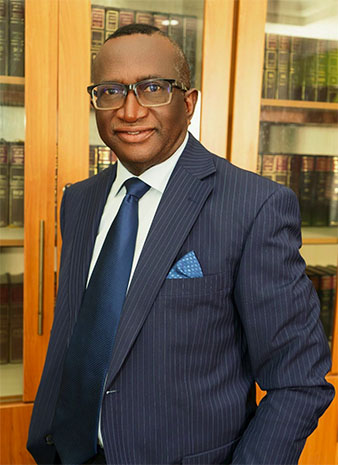
Senator Victor Ndoma-Egba, a Senior Advocate of Nigeria (SAN) and Pro-Chancellor/Chairman Governing Council of Federal University, Oye-Ekiti (FUOYE), was 70 years old recently. Born in IKom, Cross River State, Ndoma-Egba, a notable philanthropist and quintessential democrat, served as a federal board member at the young age of 24 and Commissioner at 27. He served in the Senate for 12 years between 2003 and 2015, representing the people of Cross River Central Senatorial District. In this interview, he speaks on his life at 70 and other matters. Excerpt: What would you define as your most impactful contribution to the society at 70? Maybe I will just say that I have tried to do my best. It is for the society to judge whether it was impactful or not. I tried to do my honest best in every situation I found myself. When I'm invited to do something, if I can't give it my full attention, I will reject it. I only do things that I believe i will have the time, the energy and the commitment to make a meaningful impact. You are apparently one of the few Nigerians who can be said to be successful in your generation? Why is Victor Ndoma-Egba who he is today? We all grew up in environments. Remember every environment has its card. You can't compare public office of today with the public office in the past. The society is dynamic and its values have also changed the dynamics of the society. I grew up in an environment where there were certain values, like the value of honesty for instance. In those days growing up, if your mother suspects that you were looking at something another child had, just the suspicion that you were looking at it, you will be beaten. So, I will define more of those values with the environment under which I grew up. And don't forget that I had transitional parents. When I say transitional parents. My both parents were amongst the first in our part of the world to receive western education. So, they were exposed to western education to the ways of the white man. But at the same time, they were also very traditional. They are both western and traditional. And because I had that privilege of having educated parents when education wasn't that widespread, I had the advantage of going to school. And not just going to school., I went to school early. So, in spite of the civil war I didn't lose a day from the day I entered primary school until the day I left law school. Now, people say Victor was very brilliant. I don't think so. I used to follow my mother to school. She was a teacher before she went into politics and became the first elected woman (local government) chairman in the eastern region. If I extrapolate, probably the first elected woman chairman in Nigeria, because she was elected Chairman in 1960. I was born in 1956. When she was carrying my pregnancy, she was already an elected councillor and became elected chairman four years after. But you know, we had a parliamentary system in those days and parliament was more or less part time. So, her full-time job was teaching. And I remember I used to follow her (my mother) to school when I was probably two years old. Then you were not eligible for school until you were able to touch your left ear with your right hand over head. I don't know the science behind that. But for you to be able to do that, you must be at least between five and six years old. So, I only follow her to school and most of her colleagues, fellow teachers will carry me to their classes. The person who was my godfather was teaching primary three and one of her colleagues teaching standard one will take me to their class and keep me behind. As they are teaching, I am cramming. By the time I entered school, I had already crammed everything. So, it was not a question of brilliance, but just a question of opportunity. And then like I said my mother was also in politics. My father started first as a teacher, then became a civil servant before going to England to read law. He became the first lawyer from our part of the world. What other opportunities do you think you have had? The opportunity of going to school is perhaps the major one. And then the opportunity of my faith. I was baptised the day I was born into the catholic faith. So, I have followed on in the catholic faith since I was born. And it has helped me because apart from the social values, you also have the values impacted by the Catholic faith. I went to Catholic schools all my life except for the University of Lagos. And then the opportunity of parentage. What did I do to earn the right of having educated parents - both father and mother at the same time? They were not just educated parents; they were middle class. But that did not change anything. We did the same things that other children did. We went to farm. We carried firewood on our heads. We went to the stream. It was just middle-class child in name. So, when people say I was born with a golden spoon. I say I didn't see any spoon in my mouth. At 70, what basically would say life has taught you? Life has taught me that the patient dog eats the fattest bone. Be patient and be contented. Don't be in competition with anybody. Be in competition with yourself. Because everybody has his own route. Life is like a highway. You overtake some people, some people overtake you. So, you don't have to be in competition with anybody. Just do your thing, be patient and in due time everything will come through for you. That is one basic thing that life has taught me. As an established lawyer, who has risen to the pinnacle of the legal profession, at 70, how would describe the operative environment for legal practice in Nigeria? It has changed and it keeps changing. I will give you some historic examples. When I was a child growing up my father was in law practice. That time lawyers knew their clients personally. I mean if a client came that had a matter in court, he invariably slept in his lawyer's house. I remember the number of visitors we used to have in those days. The amount of cooking that had to be done because of the visitors, mostly clients that had cases. When he too (my father) was travelling, each time he got to any town or village where he had a client, he would stop to see the client. I remember the first time when the fax machine came out, my office was the first law office in Calabar to install the fax machine. In fact, we had to buy the fax machine because we have been contacted by a client in South Korea and they wanted to send a document and they asked if we had a fax. And we said we had a fax. And my late partner went quickly to buy a fax. As we installed it, they were sending documents to us. While we were concentrating on the documents, my father walked in. He was then a high court judge. He was in Akwa-Ibom. Then Akwa-Ibom was still in Cross River State. So, he walked in unannounced. I was just watching my late partner. My father said what's that? He said the fax. And he said what that document? And I said it's from a client. And he said have met the client before. We said no. And he just said these children have wrecked this profession. Everything then requires patience. You posted a letter it took time before it was delivered. You have a document to type, you write it out first or you tell your secretary to dictate. I prefer typing myself. So, I did my typing by myself. Now we are in an age where everything is instant. Emails, whatever. As you are sending the message, it is delivering. Now you can file a document electronically. Things that were not contemplated in the early days of our practice are now realities, artificial intelligence, electronic evidence and all of those things. And as we moved technologically, there is also an impact on the value system. The values of the Gen Zs today are not our values. So, the profession has been dynamic. And I'll give you an example. When we were called to the bar, we had only one school in Lagos. And we were just 325 or thereabout from all over the country and from all over the world. And that is why even those of my set we still have that bond till today because we were not that many. We still have a platform where we relate on a daily basis. But today we have more law schools. In a day, you call five, six thousand students to the bar. In our time it was just 300 plus. So, even the number of lawyers is affecting a lot of things. A lot has changed in terms of numbers, technology, funding and so on. Sir, your dad was a legal icon and your mum a political figure. Somehow you appeared to combine these two. How has it been like being a lawyer and politician taking after your dad and your mum? Well, I keep correcting people. Even this morning, I had to correct someone that I am not a politician. I am a professional in politics. I'm not a politician. There is a significant difference. Politicians are those who live by politics and die by politics. Their only means of survival is politics. Professionals in politics are those who have alternative addresses. I have an alternative address. So, I'm a professional in politics. Going back to your question. I grew up with opportunities. But I think I realised early, I knew from the early stage of my life that I needed to speak for people. And I did that in my secondary school. If there was a problem, I was the one who spoke out. I was the one who made the case for my colleagues. So, I think I am naturally disposed to public service. I left early from my boss Dr. Kanu Agabi. My interruption was when I became a Commissioner unexpectedly. But fortunately for me I was able to go back to practice to continue with my profession. Yes, in-between I also ran for governor. Thank God I lost. Because it gave me the opportunity to build up in my profession. If I had won the election as governor, I probably wouldn't have been a senior advocate. Source: https://independent.ng/ndoma-egba-at-70-im-a-professional-in-politics-not-a-politician/
Leave a Reply
Your email address will not be published. Required fields are marked *