
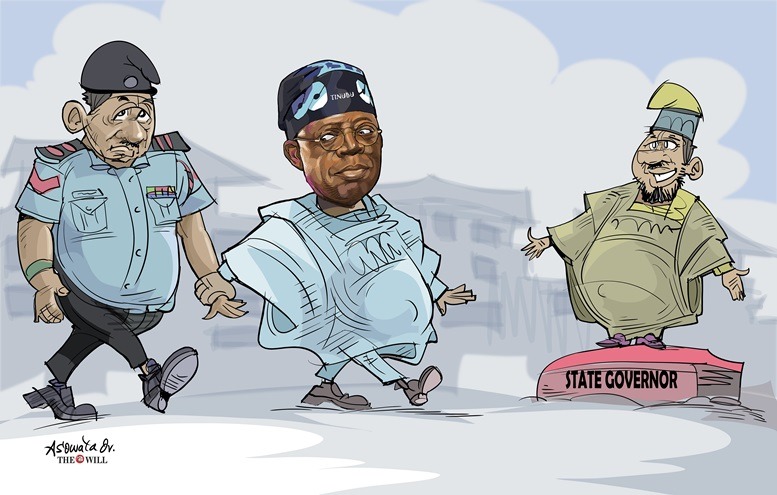
STATE POLICE: Burden or Relief for Subnationals!
- Super Admin
- 08 Mar, 2026

March 08, (THEWILL) -- In a recent viral video, Dauda Lawal, Governor of Zamfara State declared that he could end banditry in the state within two months, if given full control of the Nigeria Police Force. "With my phone, I can show you their locations today and insecurity in Zamfara would become history," the governor said, lamenting that he is often "Unable to act on this information because security forces require approval from the federal authorities in Abuja, which causes delays in responding to attacks." "If we have our own police, it means we are in charge. We're in control. We should be able to command. We should be able to tell them what to do and not to do. So, I think it is the easiest thing to do, because we know these people very well, we live with these people, and part of what we promise to do is protect the lives and properties of our people," he added. For Lawal, like most state governors, particularly in the Northeast, Northcentral and Northeast geopolitical zones, which are ravaged by sustained attacks by terrorists, state police is not an option. It is an urgency. There might be obstacles ahead, pundits say, but the situation is dire. The United Nations World Food Programme, WFP, warned on January 22, 2026, that over 1 million people in northeast Nigeria risk losing emergency food assistance within weeks due to severe funding shortages. This crisis is exacerbated by rising violence, with 35 million Nigerians projected to face acute food insecurity during the 2026 lean season. And the pronoun, 'we' which Governor Lawal kept repeating in his statement contextualises other governors' dilemma in handling insecurity in their various domains despite their Constitutional recognition as Chief Security Officers of their respective states. That sense of urgency, if not desperation, was noticeable in President Bola Tinubu's marching orders to the new Inspector-General of Police, Olatuniji Disu and his appeal to the leadership of the National Assembly, to expedite action on state police last week Wednesday, exactly one year after the President first muted the idea during a meeting with the 36 state governors at the Presidential Villa, Abuja, in February 2024, leading to the formation of a joint-federal state committee that examined and approved modalities for state policing, amid persistent challenges of insurgency, banditry, kidnapping across the states. "The political machinery to achieve state police in the country is on course and given what has transpired between the executive and the lawmakers recently, it looks like a fait accompli," a professional security and intelligence expert, Dr. Kabir Adamu told THEWILL on Friday. Adamu, Managing Director of Beacon Security and Intelligence Limited, however observed that "there are genuine pitfalls that must be noted and tackled as we move forward in our move to create state police." These pitfalls and safeguards, according to stakeholders, should get the attention of the authorities in the days ahead as the implementation of the presidential directive on state police and the promise by the National Assembly to amend the sections in the Constitutional before December, get underway. Governance issues, ethical matters, logistical difficulties, funding crisis and fiscal capacity of many state governments are central to the challenges being raised by security experts, including retired senior policemen and civil society groups that work closely with police on training and reforms, about state police. For Dr Adamu, IGP Disu's statement during the inauguration of the 8-man state police implementation committee at the Force Headquarters in Abuja on March 4, 2025, that the creation of state police would not affect the federal policing system, is a good starting point. "That is inspirational. It means what they are probably considering is a state level structure that will now have jurisdiction for certain offences, while the federal structure will now maintain jurisdiction for certain offences as it were and where the two need to work together, they can do so," Adamu said. He further said, "But we must also mention that the responsibility for creating those safeguards lies with the National Assembly which now have the mandate to amend the relevant section of the Constitution and the Police Act 2020 to address the creation of state police." Even so, experts say that amendment to the relevant sections of the Constitution and the Police Act is the easy part in the package on creation of state police. The governing All Progressives Congress, APC, as currently constituted, can muster the required constitutional numbers by virtue of its control of 30 state Assemblies and a majority in the National Assembly. The amendment requires a two-thirds majority vote in both houses of the National Assembly and approval by at least 24 of the 36 State Houses of Assembly. However, experts draw attention to the lack of accountability with past laws as a pitfall. An example is the many grey areas in the Police Act, for example, which are yet to be implemented five years after it was passed into law. Mr Okechukwu Nwanguma, Executive Director of the Rule of Law and Accountability Advocacy Centre, RULAAC, which organised a stakeholder's Roundtable on State Police in Abuja in 2024, told THEWILL in a brief interview that if crucial grey areas on administration and ethics in the Police Act have not been fully implemented five years after, the possibility of duplicating them at the state level was very high. According to him, the provisions in the Police Act relating to internal accountability, civilian oversight and the functioning of mechanisms such as the Police Complaints Unit and the disciplinary process are yet to be fully operationalised. "If the federal policing system itself has not fully embraced these accountability safeguards, replicating them at the state level without strong oversight frameworks could multiply the risk of abuse rather than solve them," he said. Arguing that the pervading fear of political misuse of state police is genuine, given the imperious attitude of a majority of state governors, Nwagunma said, "Nigeria's political environment is still characterised by weak institutional checks and balances and without strong legal and institutional safeguards, state police could easily become instruments for suppressing political opposition, intimidating critics or settling political disputes." There is also the issue of fiscal capacity of many states, many of which are still struggling to pay salaries and pensions. Only recently the Federal Government had to hold a meeting with the Nigeria Labour Congress, NLC, which had planned a strike for February 3, 2026, in the Federal Capital Territory, Abuja over unpaid allowances for workers and non-implementation of the new minimum wage in many states. Some states are still paying the old wage of N30,000. When it comes to Internally Generated Revenue, IGP, the record is worse. Apart from Lagos State which generates a wholesome, N1.3 trillion, followed by Rivers State with N320.5 billion, FCT at N282.36 billion with Ogun N194.93bn; Enugu N180.50bn; Delta; N157.79bn; Edo N91.15bn; Akwa Ibom N75,77 billion; Kano N74.77 billion and Kaduna 71.57 billion, many other states rely heavily on monthly allocations from the Federal Account Allocation Committee, FAAC. "Policing is expensive. Many states are struggling to meet basic obligations such as salaries and pensions. Establishing and sustaining police institutions-training, equipment, welfare, forensic capacity, technology and accountability systems will play a significant burden on states," Nwagunma said, adding that "without guaranteed and sustainable funding, state police risks becoming under-resourced and ineffective." Apart from these fiscal issues, there is an urgent need to enhance the state of democratic culture at the state level, Dr Adamu maintains. He called on civil society groups to support the cultivation of democratic culture at the state level as they had been doing at the federal level. In addition, he argued, if the fiscal incapacity of many states is left unaddressed, the administration of the criminal justice system will be severely impacted at the subnational level. He said, "law enforcement or the criminal justice system is not just about the police. It includes the custodial centres too, it includes the judiciary too. This is how we are going to have a functional system in place that is able to carry the entire structure of administration of criminal justice at the state level. The law allows state governments the right to set up judicial custodial centres. None of them have done that yet. There is also the ombudsman function. At the moment, it is the Police Service Commission that is fulfilling that role at the federal level. And we know that it is handicapped for some reasons, such as the appointment of a head of the Commission and funding. How do we handle these in the states?" THEWILL recalls that the immediate past President Muhammadu Buhari signed the Nigerian Correctional Service Act in March 2023 as part of the constitutional amendments in that year. The Act moved correctional services from the Exclusive Legislative List to the Concurrent List, renamed the Nigeria Prison Services to Nigeria Correctional Service with two major parts, Custodial Services dealing with confinement and Non-Custodial Service, dealing with community service, probation and parole. The constitutional amendment empowered states to build and manage correctional centers for offenders convicted of state offenses. Yet, no state government has implemented the law. Offenders are still being sent to centers run by the Federal Government. Speaking from experience, Mr Wilson Inalewawu, a retired Assistant Inspector- General of Police, AIG, said on a national television interview during the week that state police was desirable but it should be implemented progressively. "State police is something we should have," he said, adding, "I think we should practice community policing first and then proceed gradually into state policing. I also feel that we should re-equip the Nigerian Police and enable it with a better leadership structure. The major issue with policing is underfunding." Mr. Etannibi Alemika, a professor of Criminology and Sociology of Law at the University of Jos in Plateau State, who delivered the keynote address at the roundtable on state police organised by RULAAC, supports Inalewawu's viewpoint with empirical evidence. In his presentation entitled, "Decentralisation, Democratisation and Police Effectiveness: State Police or What?", Alemika "offered a thoughtful caution against simplistic assumptions that creation of state police would automatically resolve Nigeria's deepening insecurity." According to the don, even the United States which operates one of the most decentralised policing systems in the world is still not free from significant insecurity as the country continues to grapple with serious levels of violent crime and mass imprisonment. He stressed that the focus on creating state police must be stripped of ethnic suspicions and political calculations aimed at controlling instruments of coercion at the state level. "One option could be local government policing with state-level oversight, similar to how local government service commissions operate. Another is the creation of state police forces with federal oversight, comparable to the supervisory role played by the Nigeria Judicial Commission. Whichever model is adopted, the Constitution should establish minimum national standards governing recruitment, training, command structures and accountability mechanisms. State laws could then regulate operational matters such as conditions of service," he said. He added that the amended section of the Constitution should specify maximum permissible weapon calibres for state police force, lower that those used by the Nigeria Police Force. Also, federal authorisation, he said, should be required for acquisition of firearms and ammunition while states should be free to buy non-lethal equipment such as surveillance devices and protective gear. "Is the insecurity in Nigeria due to state police.? I think there are many reasons. Corruption, politicisation, and weak governance are the major challenges of insecurity and they should be addressed as well," AIG Inelawawu said, adding that the duplication of policing functions in other security outfits like the Federal Road Safety Corps, the National Security and Defense Corps have created problem of coordination and rivalry among security outfits tasked with the investigation, intelligence gathering and prevention of crime. He was alarmed that the government chose an election year to start the implementation of state police, stating that past experiences in the first republic when the regional governments used and abused their police for intimidation and oppressions of rivals was still a looming possibility. While the urgency created by widespread insecurity has pushed state police higher on the agenda, the success of any such reform will depend on careful legal design, clear accountability mechanisms, professional standards and safeguards against political abuse, argued Nwagunma. Source: https://thewillnews.com/state-police-burden-or-relief-for-subnationals/
Leave a Reply
Your email address will not be published. Required fields are marked *