
Decarbonising Africa: An urgent response for holistic climate action - Businessday NG
- Super Admin
- 08 Mar, 2026

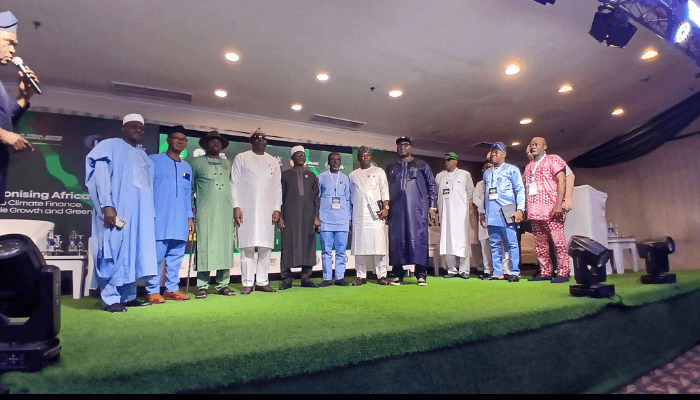
For many African economies, the need to industrialise and decarbonise is more urgent now than ever before. However, not everybody within the ecosystem understands the need to decarbonise just as the continent is trying to play catch-up with the developed economies. That gap in knowledge necessitated the Green Conference 2026; a 3-day project implementation retreat held in Lagos to explore the different ways Africa can leapfrog her climate challenges to deepen conversation on green economy and growth. Themed, 'Decarbonising Africa: Pathway to Climate Finance, Sustainable Growth and Green Economy,' the green conference was organised by Greenplinth Africa Limited as part of initiatives to accelerate Nigeria's response to climate change and sustainable development. "Africa stands at a pivotal moment in the history of global development," Omotenioye Majekodunmi, DG, National Council on Climate Change (NCCC), said in a keynote address titled, 'The Pragmatic Pivot to Gas: Powering Africa's Industrial Transformation in a Carbon-Constrained World.' According to her, Africa is the youngest continent on earth that is rich in resources, rich in innovation, and rich in human potential. However, hundreds of millions of Africans still live without reliable access to modern energy. Majekodunmi said industrialisation remained both an economic necessity and a moral imperative for Africa. She added that while the continent was struggling with industrialisation, the global energy system was undergoing a historic transformation as the world accelerates toward decarbonization, which creates a unique challenge for Africa. "While many advanced economies industrialised through two centuries of carbon-intensive growth, Africa is now being called upon to build its industries while simultaneously aligning with global climate objectives. "In essence, Africa is being asked to industrialise and decarbonise at the same time. The real question before us therefore is not whether Africa should decarbonise. That objective is already clear and widely shared," she said. According to her, the real question is how Africa can achieve industrial growth, energy security and economic prosperity while advancing the global climate agenda. The NCCC director general said Africa will not choose between development and decarbonization. "Our task is to achieve both - and to show the world that responsible development and climate leadership can advance together." The carbon market For many African economies, the answer to climate change demands lies in a pragmatic and balanced energy transition, where natural gas plays a critical enabling role. "Just to say that more than ever before, we all need to be at it because this is an era of challenges due to climate change. However, on the other side of the pendulum is the opportunity tied to it. "And one of such ways of ensuring that the opportunities are harvested is through the carbon markets. And so what we're doing here today is to see how through the projects by GreenPlinth we are able to get that done," Eugene Itua, CEO, Natural Eco Capital and executive director, Africa Green Economy and Sustainability Institute (AGESI), said. According to him, all stakeholders must collaborate towards mobilizing the needed finances to accelerate climate actions to help Africa deal with the challenges. He added that there is a need to deepen the knowledge, deepen the understanding of the carbon market. "My call to action is that all of us work together, deepen the understanding because interestingly, all of us want to play one role or the other in the carbon markets, but not everyone understands the dynamics," he said. However, Majekodunmi said that gas provides the reliable base load energy required to power Africa's industrial activity - from steel and cement to chemicals and fertiliser production - while also serving as a stabilising partner for the rapid expansion of renewable energy systems. "In Nigeria, this approach is reflected in what I like to describe as an 'Energy Mix Plan' - a transition strategy that recognises the complementary roles of gas, renewables, and emerging low-carbon technologies," Majekodunmi said. According to her, natural gas supports Nigeria's transition in several critical ways. She disclosed that by replacing coal and heavy fuel oil, gas can reduce greenhouse gas emissions by up to 50 percent while dramatically improving air quality. "Gas-to-power systems provide the flexible backup generation needed to support solar and wind deployment at scale. Gas-derived hydrogen and feedstocks underpin vital industrial processes including fertiliser production and petrochemicals," she said. According to Majekodunmi, liquefied petroleum gas offers millions of households a cleaner alternative to biomass and kerosene, improving health outcomes and environmental sustainability. The NCCC director general added that Nigeria alone holds more than 600 trillion cubic feet of proven gas reserves - resources that, if responsibly developed and decarbonised, can support industrial growth while contributing to global climate objectives "To investors, the message is clear: The future is not simply gas or renewables. The future is decarbonised gas working alongside renewable energy systems. "Let us use the resources beneath our feet to power the prosperity above our heads - building an Africa that is industrialised, resilient, and climate responsible in a manner," Majekodunmi said. 80 million clean stove initiative On the sideline of the green conference, a Memorandum of Agreement (MOA) was signed between Greenplinth Africa, Benue, and Niger states - forming the bedrock of a strategic partnership for green economy and greening initiatives - deployment of clean cookstoves and innovative tree planting and nurturing program (hereinafter referred to as "the project"). The Project, which is a United Nations Framework Convention on Climate Change (UNFCCC) Global Climate Action Portal (GCAP) registered Initiative and is designed to distribute highly efficient improved cookstoves for free to women, low-income earners, poor families, and households across the states - drastically reducing the level of traditional firewood consumption during cooking to 100 percent no firewood. The Nasarawa State government was represented, although the state is yet to sign the MOA. Conceptually, the Clean Cookstoves Project is a transformative initiative, and a significant step forward in combating the adverse health and environmental impacts associated with traditional cooking methods, such as indoor air pollution and deforestation. Under the MoA, two million clean cookstoves will be deployed to women and households across the two states at no cost to the beneficiaries, with each beneficiary receiving one stove and two pots. The provision of free clean cookstoves is expected to transform the lives of millions of people in the states, particularly women and children, who are disproportionately affected by the harmful effects of traditional cooking practices Also, the initiative will include the planting and nurturing of 100 million economic trees across the three Senatorial Districts of Benue, Niger and Nasarawa States. The innovative tree planting and nurturing will help to eliminate or reduce poverty, hunger, and diseases; as well as form the basis of establishing green smart sustainable communities in all the local government areas across the states. Climate champions The two states that signed the MoA with Greenplinth Africa and Nasarawa state were all recognised for their proactive drive towards decarbonising their individual states. Receiving the Climate Champion awards on behalf of the Governor of Niger state, Umar Bago, the commissioner, Environment and Climate Change, Niger State, Abubakar Musa, thanked Greenplinth for the recognition. "The award that was given to our governor, because of his commitment to the environment most especially in the area of climate sustainability. We had this Green Conference in the first year that he came into power. It was one of the first things that he made us understand. This recognition shows that we are in the right direction," he said. On his part, Daniel Galadima, the Director General, Niger State Agency for Green Initiatives who also signed the MoA on behalf of the state expressed confidence in Greenplinth Africa's clean cookstoves campaign noting that it is a step towards democratising access to clean energy. Sam Ode, deputy governor, Benue State, who led the state delegation, expressed satisfaction at the event and said that the government attached so much importance to issues around climate change. Ode said: "One remarkable thing that has taken place at this conference is that the state government has signed a memorandum of agreement with GreenPlinth Africa towards the decarbonisation efforts. And for us, this is quite fundamental. We're going to comply with global best practice in this direction and we're hoping that it will be for the benefit of mankind." The event featured some masterclasses delivered by knowledgeable members of GreenPlinth management and other resource persons. Source: https://businessday.ng/life/article/decarbonising-africa-an-urgent-response-for-holistic-climate-action/
Leave a Reply
Your email address will not be published. Required fields are marked *