

Despite Food Price Crash, Ginger Remains Out Of Reach - Daily Trust
- Super Admin
- 07 Mar, 2026

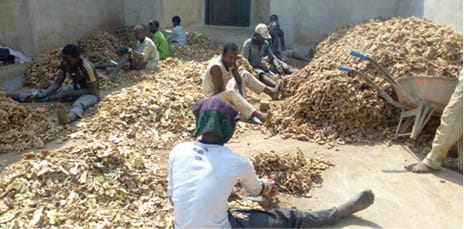
Despite a crash in the prices of grains and other food crops in the country, the price of ginger has defied decline, remaining high in the market. Nigeria is a major producer and exporter of ginger, ranking second globally with an annual production from 500,000 to over 800,000 metric tones, driven by small-scale farmers in Kaduna State, according to figures from the Federal Ministry of Agriculture and Food Security. However, it declined significantly in 2023 and 2024 due to blight. But despite these challenges, Nigeria remains a key player in the global ginger market. Kaduna State is the leading producer, contributing over 70 per cent of the national output, according to Tridge analysis on the ginger industry in Nigeria. Other significant producing states are Nasarawa, Niger, Gombe, Federal Capital Territory (FCT), Bauchi and pockets of producing belts across other states. The Federal Ministry of Agriculture estimated that more than 2,500 hectares of crops in seven southern Kaduna local government areas estimated at N12 billion was destroyed. Nigeria's ginger harvest is exported to international markets, with notable demand originating from India, Saudi Arabia, the United Arab Emirates, Netherlands, China, among others, according to the Nigeria Export Academy. Due to pest attacks in 2023, the industry is yet to recover from the disease, straining the country's ginger, which is highly valued for its robust flavour and high oleoresin concentration. As a result, ginger supply and farmers' productivity continue to decrease, causing scarcity and high cost for many households. For many farmers, it was a nightmare. Emmanuel Gabriel, a ginger farmer from Kuturmirimi community in Kachia Local Government Area, who used to harvest 600 bags of ginger, suffered losses that reduced his output to just 20 bags due to attacks. As the supply declines, prices in the last few years have stayed high across the country. Our correspondent gathered from various major markets across the North that a bag of dried ginger, which used to sell at N180, 000, now costs N600,000 to N610,000. Three years ago, a measure (mudu) was sold at N2, 700, but today, it costs N28,000. However, the price of ginger varies based on the type and its purity, in terms of dust and other unwanted particles. Although some people prefer fresh ginger, most users and exporters depend on the dried type. Alhaji Isah Garba, a major player in the Yankaba spice market and a ginger farmer in Kaduna State for decades, said the surge in ginger price was due to increased global demand. He also said the discovery of numerous health benefits associated with ginger was another factor contributing to the commodity's price increase. Garba explained that pest infestation, which started in 2023, significantly reduced ginger production, resulting in a severe scarcity of the commodity in Nigerian markets. "Ginger farmers encountered a serious pest attack in the last three to four years; and they are yet to recover. This attack has seriously affected availability as yield was also affected. There has also been an increase in the export of ginger due to high demand for the Nigerian species," he revealed. According to Alhaji Hamisu Inuwa, a merchant who has been dealing in the crop for many years, the Nigerian ginger is currently in high demand globally as against the initial export status of the spice. He explained that the demand, particularly in Europe and Asia, with the Netherlands serving as the largest importer of the Nigerian ginger, followed by countries like the United States, India and China, affected the commodity's domestic availability and price. Alhaji Bello Guri, a merchant who claims to have been in the ginger industry for over three decades, said the commodity had never been priced at this level in recent years. He added that some of the factors contributing to the high price of ginger in Nigeria are the commodity's export demand and the growing knowledge of its therapeutic value. Alhaji Bello contended that the rising cost of ginger is a result of domestic scarcity brought by export demand as not all households can afford the product, making what was once freely accessible scarce and untouchable in the market, adding that ginger is gradually becoming a money-spinning crop in the country, after cocoa. A ginger exporter, Mr Simon Agbor, said Nigeria was the largest producer of the commodity in Africa and the second largest in the world with a production share of 16.9 per cent after India, which has a production share of 43.8 per cent but is yet to dominate the global market. "Even with its large production, Nigeria is only a small contributor to global ginger exports. Nigeria only came to the world stage for ginger, starting in the 1990s given a strong domestic ginger market. This is similar to India, which accounted for just 3.0 per cent of global ginger exports in 2019, even with its world-leading production, because of robust domestic demand," he revealed. Our correspondents who spoke to some consumers report that ginger is now optional in their menu as prices are beyond their reach. Mrs Fatima Abubakar said it's hard to get N200 ginger as the price of few collections ranges from N500 and above. "If the sellers give you N500 ginger you would be amazed. The price is something else. I used to use it in kunu, but I have to drop it because it is too expensive," she said. Mrs Ijeoma Ifeanyi, a food vendor, said the use of ginger in food was declining because N1,000 would only give her few dried slices. She added: "Ginger has no alternative; it is either you use it or you forget about it." An ardent ginger user, Mrs Nabila Aminu, said the commodity had been transformed into gold and only a few people can afford it. Mrs Aminu said she used ginger in her tea, as spices when cooking and as ingredient when preparing her favourite juice, but she could not do any of these things anymore due to high cost. "It is not possible to spend almost N6,000 to prepare a juice. And I hate using all these flavours we don't even know what they were made from. I really loved using ginger, but I have no option but to let it go because I cannot afford it now," she said. Mrs Janet Offor, a juice producer at Dutse market, told Weekend Trust that she no longer prepared ginger juice as people complained about price. She said, "I stopped doing ginger juice because when you tell people the price, they complain. Some of them don't even know how expensive it is in the market. What I decided to do is mix juice with a little blend of ginger." Malam Saidu Ahmed, who sells spices in the market, said that among all the spices, ginger is something else, adding, "Turmeric is cheaper, garlic is cheaper, but ginger is too expensive." The Minister of Agriculture and Food Security, Senator Abubakar Kyari, said the federal government was actively combating the ginger blight pandemic impacting Nigerian farmers. He set up the Ginger Blight Epidemic Control Task Force last year to focus efforts on finding long-term solutions to the destructive illness. The task force, led by Abubakar Abdullahi, an engineer, has been developing measures to tackle the blight, including assisting 5,000 farmers in Kaduna, the main producing hub. The National Agricultural Development Fund (NADF) has been mandated to intervene in the ginger sector with a N1.6 billion support package, specifically targeting farmers affected by the ginger blight epidemic in Kaduna, Plateau, Nasarawa and the Federal Capital Territory. Source: https://dailytrust.com/despite-food-price-crash-ginger-remains-out-of-reach/
Leave a Reply
Your email address will not be published. Required fields are marked *